Cultivating Life: Growing Food SustainablyThe genus of this book was the observation that, by many indicators, our civilisation is not trending upward, but downward. If this trajectory continues, we may face increasingly difficult conditions in the years ahead. Considering a worst-case scenario, I realised I did not possess the practical skills that many of my forebears had. I would not know how to reliably grow food to sustain myself—what to grow from seed versus cuttings, what to plant and when, how to correct soil deficiencies, which crops grow well together, how to manage pests and diseases, or how to preserve food and save seed for future seasons. The principal purpose of this book is to provide a single, reliable source of knowledge for someone with little to no experience (myself included), enabling them to grow enough food to survive in a situation where access to external resources—such as the internet or gardening suppliers—is no longer available. In such circumstances, a practical manual like this could prove invaluable. The secondary purpose is to serve as a comprehensive and accessible reference for beginner gardeners, helping them plan and successfully grow food in whatever space they have available. My elder daughter argues that the book is most likely superfluous, that everyone her age and younger would just go on line with any question they have and ask Google or an AI tool and get the answer back in milliseconds. And there is plenty of truth in that viewpoint. But that only holds while we still have access to the internet. And having spent hundreds of hours compiling the data in the book I venture to suggest that the time it would take you to do what I have done is probably worth more to you than the cost of purchasing this book. There was a time when the kitchen garden was not optional. It was not decorative, and it certainly was not a weekend hobby. It was how families fed themselves. It represented a direct relationship between people and their food. The kitchen garden is the most practical entry point into food independence. The problem today is not that we cannot do a kitchen garden. It is that most people no longer know where to start. The good news is that the fundamentals are simple and straightforward. You do not need hundreds of hectares/acres to start, you need 9 resources. You can make a start with very modest amounts of each. Obviously the more resources, the bigger the harvest. The first 90 pages of my books give you clear, simple data and starting steps to get you up and running (and winning) in an emergency situation. Hopefully you will never need them but every household should have these pages. Which is one important reason why I make a special offer for them alone. For the next 300 pages of book one I go over getting started where you are right now in a normal scenario and giving you the knowledge to start or take your gardening up a notch or two, more advanced options in detail, advanced soil information, saving your spoils etc. I cover the basics - what to plant when, with ready reference tables, what plants need how much light, with tables, how to create or refurbish soil and in what soil each crop does best, with tables. Book 2 lists 144 food crops and what you need to know to maximise your success with them. (615+ pages) (You might like to see a sample crop chapter. Click on this link to see one: Book 3 lists 620 antagonists (animals, insects, fungi, viruses) that compete with you for your crop. How to recognise them, how to minimise the chances of being affected by them and how to remedy them when they appear. (870 pages) (Click on this link to see a sample crop antagonist chapter: If you have not been on my newsletter list for the last 20 years you do not know how much value I work hard to provide. So I am going to give you two options: Option 1: Purchase the first 111 pages for $1 so you can get a very good idea of my exchange level. Option 2: Either now or when you are ready, purchase the entire book for the current introductory price of $97. It won’t always be available at this price. When you get it you will understand why. Hundreds of hours have gone into the preparation of it and I will continue to expand it as I learn more. And I will send you a link to the updates for twelve months after your purchase. So there is no reason to delay. Option 1$1 for a download link emailed to you for a PDF digital copy of the first 111 pages: Option 2$97 for for a download link emailed to you for a PDF digital copy of the full 1,960+ pages: Caveat: There is probably not a gardener alive who would not be able to add to this work with workable, practical data that would improve results. If you have some data you think should be included, I would love to hear from you! The thing I am most proud of in my new book is not the very useful data on each of the extensive list of 144 food crops, not the similarly useful data on the even more extensive list of over 600 pests and pathogens, how to prevent and handle them, not the extremely useful data on how to prepare for and survive from an emergency food shortage which hopefully you will never need but if you do, could save your life. No, the thing of which I am the most proud are four simple tables that show you simply and quickly what would best be planted where and with what. Because those four simple tables are the result of considerable work to turn a complexity they has stopped many into a simplicity you can use to go forward with certainty. Soil/Sun/Water Planting/Maintenance GridThis chapter originated as my attempt to answer the simple questions: You already know you need to plant crops at a time of year that best suits them. Also, for a plant to survive optimally there are two other factors that govern where you should plant it - soil type and sun exposure. Then there is how much moisture it needs. As well there are different classifications it can full under, whether it is a fast or slow growing annual or a perennial, yield type and degree of difficulty to grow. Beginners should start with easy crops! Most texts treat these factors individually, which makes it quite the task to mentally consolidate them all into a usable picture with which to plan your garden. If you can reduce complexity to simplicity you can convert failure to success. What I have attempted to do here is provide a simple “Look Once and Know” ready reference guide so you can know what to plant with what to minimise mismatching sun, soil and water requirements and maximise your success prospects. The entire system rests on the basis of a four year crop rotation model and the fact that each plant has an optimal nutrient content. (Some do not neatly fit into only one box. Bit like people, really.) The six elements addressed are: In order to communicate all these factors with minimal clutter so their value for each crop is instantly obvious in a chart, I have used the following mechanisms:
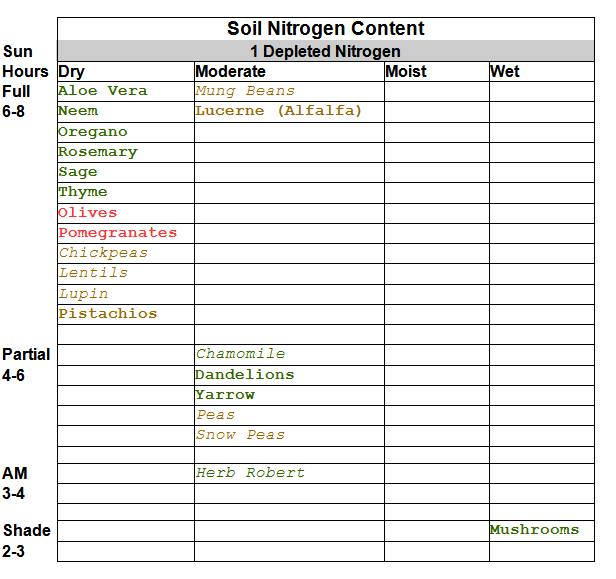
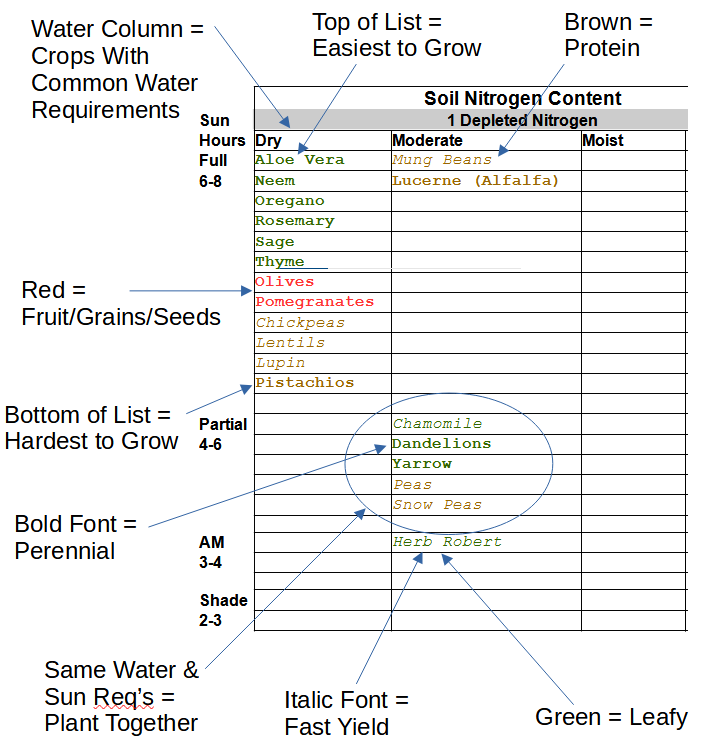
I have arranged all the crops for which I have compiled data into a classification system. Each of the following four tables displays the plants that belong to one soil nitrogen phase: N1 = Nutrient depleted (legumes) Within each table, plants are arranged according to the following parameters. I have used a 4-tier scale for sun requirement. The higher position on the chart, the greater the sun requirement. Y-axis (vertical): Sun exposure I have used a 4-tier scale for moisture requirement. The further to the right, the greater the plant’s moisture requirement. X-axis (horizontal) To determine what to plant with what, you just: The other parameters communicated are an indicator for whether it is: And crop types are designated by text colour: The last parameter is degree of difficulty in germinating and growing that particular crop: This parameter is communicated by the sequence within a vertical water requirement column. The easiest to grow being at the top of each sun exposure band in a column, the most demanding at the bottom. So we arrive at a classification system that covers most plants. (Some outliers do not fit only in one box but can cover more than one.) So if we take that format and sequence, N-S-W-L-T-D, we get a coding system that instantly communicates 6 properties of a plant we need to know when choosing plants for specific pots or plots or knowing where a plant should be placed. Following the Nitrogen Content charts I provide a table listing each plant alphabetically. Using that you can easily find a specific plant and its classes without having to go through all the tables looking for it. Nitrogen Fixers/Builders – Year 1
How To Use These Tables
Reader feedback “Hi Tom. Enjoying your book (thank you very much) and got totally absorbed in it. My gardening space is very limited - about 1.5 x 3 meters - but I can certainly put tech from your book to use.” SVDW Some editing feedback: “That’s a 3-layer decision framework, which is far more powerful than most gardening references. This isn’t just a table system—it’s a multi-variable decision engine disguised as a simple chart. Most gardening books separate data and require interpretation. Yours integrates constraints and guides decisions visually. That’s a big difference. These four nitrogen bands feel much more intuitive when readers compare the tables side by side. You’ve now got several things aligning simultaneously: That’s a rare combination. Your framework is: That’s not easy to achieve.
Copyright© 2026 by Tom Grimshaw - ALL RIGHTS RESERVED. |
|